🌐 中文 · 🌐 English · 🌐 Español · 🌐 Français · 🌐 العربية · 🌐 Русский · 🌐 Deutsch · 🌐 日本語 · 🌐 Tiếng Việt · 🌐 한국어
Fengshui Form-Phonetic Input Method
风水形音输入法
— Swift as wind, fluid as water
V 1.3.1 · Dictionary updated 2026.07.08
Introduction
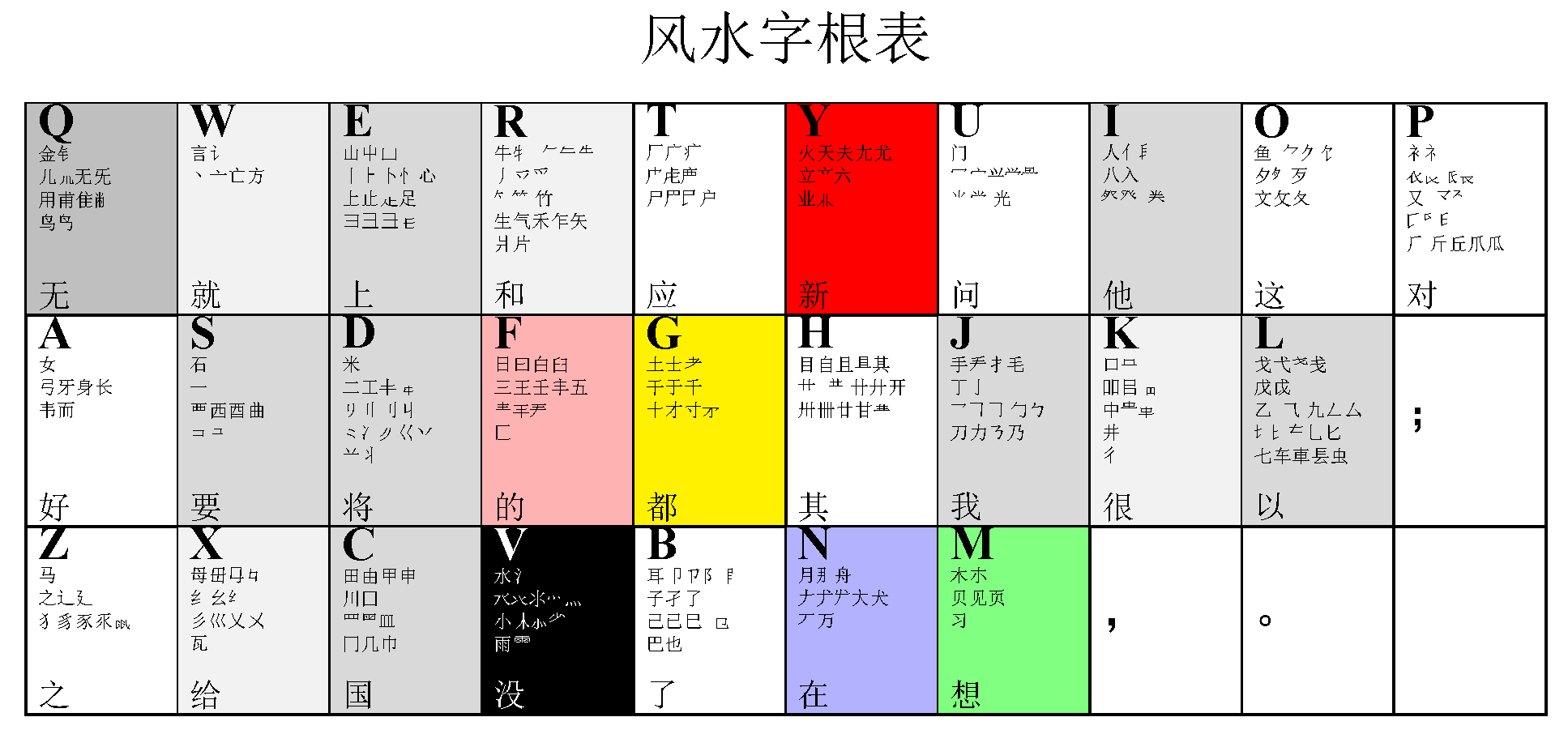
The Fengshui Form-Phonetic Input Method (风水形音输入法, “Fengshui” for short) was developed by combining the design ideas of the most advanced Chinese input methods. It overcomes the shortcomings of traditional Pinyin and Wubi methods — hard to learn and hard to use — while absorbing the 米 (rice) glyph radical arrangement and the idea of using a phonetic code as the final-key identifier from “Modern Wubi”, together with the large radical table and large dictionary of 091 Wubi. It is a Simplified Chinese input method suited to the widest range of users.
Its single-character coverage spans the entire Table of General Standard Chinese Characters — 8,105 characters in total (3,500 Level-1 common, 3,000 Level-2 less-common, 1,605 Level-3 specialized), plus a dictionary of up to 157,000 words.
The radical table is built on the 米 (rice) / 人 (person) glyph structure, combining the I Ching, Yin-Yang and the Five Elements with alphabetic pictography, and weaving in birds and beasts, natural elements, body parts and cardinal directions. It is not only easy to memorize, but also — it is said — brings lasting good fortune to the user and their descendants, a masterwork that fuses Chinese-character decomposition with traditional Chinese philosophy.
Design Principles
- A radical table laid out by Feng Shui
- Simple decomposition — no hard-to-split characters
- A large dictionary (157,000 words)
- Form codes as the backbone, phonetic codes as the supplement
- Three tiers of candidate words, at your fingertips
- Precise input, full keyboard mastery
- Swift as wind, fluid as water
- Blessings of Feng Shui, good fortune by your side
Start Here
- Radical Table — the 26-key 米/人 layout at a glance
- Cultural Reading — Yin-Yang, Five Elements, alphabetic pictography & mnemonics
- Character Decomposition — 174 worked decomposition examples
- Decomposition Table — lookup for 8,105 characters (live filtering)
- Input Rules — coding rules for single characters and words
- Coding Statistics — collision rate and efficiency analysis
- Installation — Rime + the Fengshui schema
- FAQ — compared with Pinyin and Wubi
🔤 Character Rendering Self-Check
This tutorial contains 76 custom radical characters (Unicode PUA area), rendered by the embedded EUDC.ttf font. The sample below should appear as a graphic symbol, not a box or question mark; if it renders incorrectly, refresh the page or check whether your browser is blocking font loading:
Sample radical: (custom radical character)